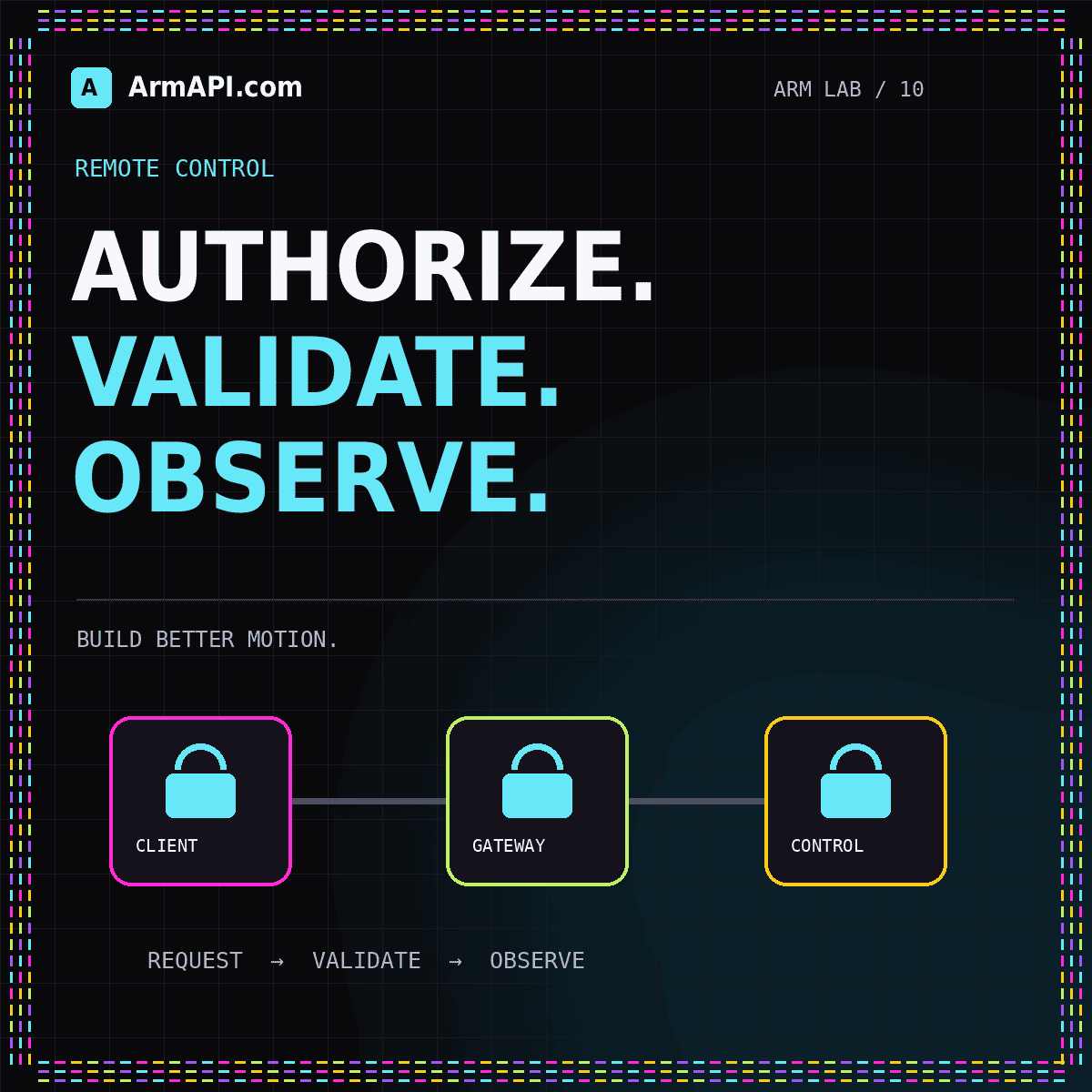
Robot arm API security begins by identifying which requests can change the world and which components are allowed to authorize them. Encrypting a connection is important, but it does not decide whether a particular user may move a particular arm in its current mode. A secure-looking transport can still carry an unauthorized or ambiguous command.
This guide develops a software review checklist for a hypothetical robot application gateway. It is not a penetration test, a certification, or a substitute for machinery safety engineering. The Remote Control Arm API page explains the system boundary, and the safety notes distinguish browser controls from independently engineered protective functions.
Map assets and trust boundaries first
Draw the browser, gateway, robot-facing adapter, controller, observation sources, and administrative tools as separate components. For each connection, record who initiates it, what data crosses it, and what authority the receiver grants. This simple exercise often reveals that a convenience integration has access to much more than its task requires.
Identify the assets that matter. They include command authority, configuration integrity, credentials, observation availability, and the ability to reconstruct a task’s outcome. A robot’s camera feed may also contain sensitive surroundings. Treat confidentiality, integrity, and availability as distinct concerns rather than assuming that protecting an API key covers the whole system.
Write a small threat scenario for each boundary. An observer attempts a command. A stale session tries to reclaim control. A modified client submits an unsupported tool action. An internal adapter returns malformed state. These scenarios make the review concrete without requiring a large generic checklist disconnected from the application’s actual behavior.
Require authorization for the specific operation
Authentication establishes an identity; authorization decides what that identity may do. Check both the requested operation and the specific resource it targets. Permission to observe one arm should not imply permission to move another. Permission to request a reviewed task should not imply permission to change joint limits or operating configuration.
The OWASP REST Security Cheat Sheet recommends controls including HTTPS, endpoint-level access control, input validation, and careful handling of tokens and errors. These documented practices support the software boundary discussed here. The robot-specific ownership and command-state examples below are independent design proposals, not an assertion that following a web checklist makes machinery safe.
Keep policy enforcement on the receiving side. Hiding a button can improve the interface, but a modified client can still construct a request. Validate the current session, operation scope, target resource, and relevant state each time. Do not rely on a permission result cached when the page first opened.
Keep secrets out of the browser bundle
A static website cannot keep a secret that it sends to every visitor. Do not embed privileged robot credentials, private service tokens, or administrative signing material in JavaScript, HTML, or downloadable examples. Obfuscating a string does not turn client-delivered code into protected storage. The ArmAPI demo uses no credentials because it only changes local illustration state.
For a separate production gateway, define how credentials are issued, scoped, rotated, and revoked. Use the least authority required for the component’s task. A read-only observation service should not share a broad credential with a command adapter simply because that is convenient during development.
Review error handling and logging for accidental disclosure. A diagnostic message should not return a token, internal secret, or full sensitive payload to an unauthorized client. Keep useful correlation identifiers so operators can investigate without exposing the details of internal infrastructure through every failed request.
Validate meaning as well as syntax
A payload can be valid JSON and still be an invalid motion request. Check joint names, units, frames, finite numeric values, required fields, and allowed operations. Reject ambiguous or unsupported combinations. Do not silently convert unknown units or substitute a default frame when the caller omitted information that changes the command’s meaning.
Also validate against the current configuration. A tool identifier, model revision, or operating mode may have changed since the client read capabilities. Tie planning and execution requests to the context they were prepared against. When that context no longer matches, return a clear conflict or review-required result instead of executing under new assumptions.
Bound resource consumption. Limit payload sizes, request rates, and expensive operations according to the application’s requirements. These controls help protect availability, but they should not make emergency or local protective behavior depend on a web quota. Keep the architecture’s safety functions independent of ordinary application traffic and its resource policies.
Prevent duplicate work and conflicting ownership
Assign stable identifiers to logical commands and define receiver-side duplicate handling. When a response is lost, the client should retrieve the existing command’s state rather than blindly submitting another motion. Make conflicts visible when an identifier is reused with different content. The remote-control latency guide explains why uncertainty is a normal condition that the protocol must represent.
Enforce command ownership at the gateway or another clearly designated authority. Two valid users should not automatically be able to issue incompatible requests at the same time. A lease, reservation, or reviewed handover can express ownership, but its behavior must be specified for expiry, reconnects, and already accepted work.
Do not let reconnection restore authority implicitly. A returning client needs fresh state and current permission checks. Equipment may have been controlled locally, serviced, or placed into another mode while the connection was absent. Treating the old browser session as an uninterrupted source of authority can preserve assumptions that are no longer true.
Log outcomes without inventing certainty
Record the request identity, actor, target, policy result, configuration revision, and execution outcome where available. Distinguish rejected requests from accepted work and completed work. A log entry saying command sent is not evidence that the arm moved, and a missing result should remain unknown rather than being filled with an optimistic default.
Protect the logs themselves. Limit who can read or modify them, define retention, and avoid collecting more sensitive content than the investigation purpose requires. Operational records should support accountability without becoming a second uncontrolled store of credentials, private images, or personal information.
Test reconstruction as part of the review. After a simulated failure, ask another developer to explain what was authorized and what is known to have occurred using only the records. If the answer requires guessing, improve the event model. An audit trail is useful only when its terms correspond to actual system states.
Review the deployment surface
Inventory what is actually shipped to the client and exposed by the hosting environment. Inspect scripts, source maps, downloadable examples, debug routes, and configuration files for secrets or unintended command access. A careful application policy is undermined when an old demonstration endpoint remains reachable with broader permissions. Keep development fixtures separate from production configuration and document which public paths are intentionally available. Repeat this review when deployment tooling changes, not only when the robot code changes.
Also test denial paths from the user’s perspective. An unauthorized request should leave the command state unchanged and return a useful, nonrevealing explanation. The interface should not optimistically animate an operation that the authority rejected. Verify that the audit record preserves the rejection and that repeated denied requests cannot quietly acquire ownership. These checks connect security policy to observable application behavior instead of treating it as a separate document nobody exercises.
Conclusion: make authority narrow and inspectable
A practical robot arm API security review starts with trust boundaries, scoped permissions, protected credentials, semantic validation, and recoverable command identity. It also checks how ownership and uncertainty are represented when clients disconnect or disagree. These controls support a better application architecture; they do not replace physical safeguards or qualified commissioning.
Use the simulation test plan to exercise rejected requests, stale sessions, and unknown outcomes before adding hardware. For agent-driven workflows, review bounded agent tools so model-generated requests pass through the same enforced boundaries. A useful rule is simple: no interface should gain more authority merely because it is convenient to connect.


