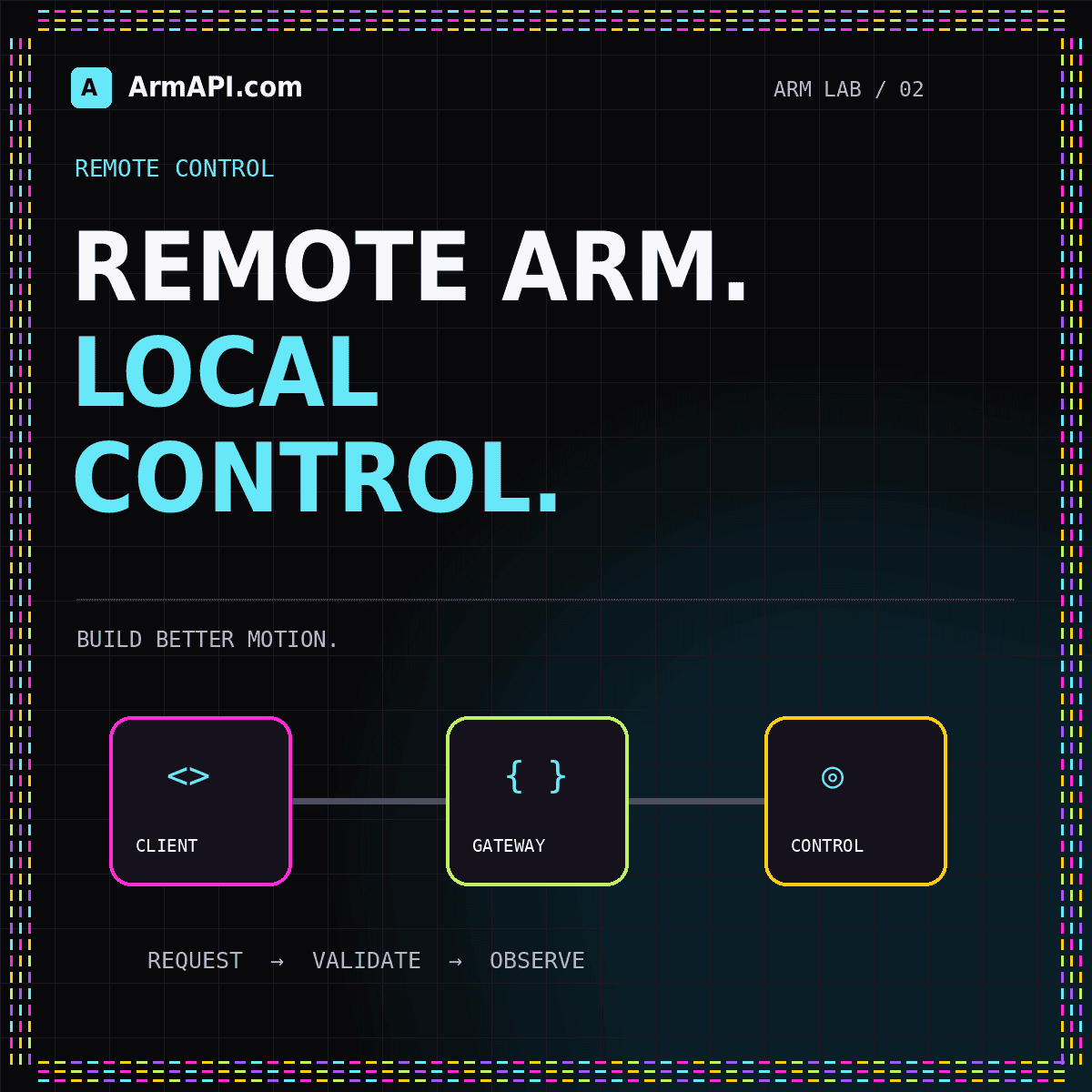
Remote robot arm control is not simply a local control panel delivered over a longer cable. The operator sees observations that were captured earlier, commands take time to arrive, and the connection can disappear after a request is accepted. A convincing interface must represent those gaps rather than covering them with smooth animation or a permanently green connection badge.
Consider a hypothetical teaching cell observed from another room. The user selects a reviewed motion, sees progress, and can request cancellation. This guide proposes an application architecture for that situation; it does not prescribe safety-rated timing or connect to a real arm. The Remote Control Arm API overview explains the larger separation between a browser, an application gateway, and local robot control.
Define what remote control is allowed to mean
Begin with the task. Selecting a stored motion, requesting a camera view, and continuously steering a joint are different interaction models. They should not share a vague remote-enabled switch. For the teaching cell, start with a small set of reviewed actions and a read-only observation view. Avoid exposing unrestricted low-level commands merely because the transport can carry them.
Write down the permissions for each participant. An observer may see state without owning command authority. An operator may request a task within an approved workspace. A maintainer may change configuration only through a separate workflow. Keeping those roles distinct prevents the visual presence of a control from becoming an accidental permission grant.
Make local operating conditions authoritative. A browser should display whether a task can be requested, but the receiving system must independently check whether it is allowed now. A page that was opened earlier may have obsolete knowledge about ownership, tool configuration, or operating mode. Fresh validation belongs at the point where the request could cause action.
Measure several kinds of age, not one latency number
A single latency badge hides too much. Separate observation age, request travel time, application processing time, and outcome notification delay. For an engineering test, record timestamps at meaningful boundaries and document which clocks produced them. Subtracting timestamps from unsynchronized machines can create a precise-looking number that does not describe the actual delay.
For the interface, the most important question may be how old the displayed robot state is. A low network round trip does not prove that a camera or state publisher is producing fresh data. Show observation time directly, and use a clear stale state when updates stop. Do not keep moving the displayed arm through a predicted trajectory while presenting the picture as measured reality.
The ROS 2 design discussion of deadline, liveliness, and lifespan distinguishes message intervals, signs of publisher life, and data validity. Those concepts provide useful vocabulary for this problem. The document is a design reference, not a promise that every middleware or deployed configuration implements every policy identically. Verify the selected implementation separately.
Separate the control path from the display path
A video stream and a motion request have different purposes. Treating them as a single connection can make a large media transfer obscure a small but important command event. In the proposed teaching-cell architecture, observations flow toward the interface, while validated task requests flow through a deliberately narrow command gateway. Each path has its own health and failure reporting.
Keep time-critical control near the equipment. The remote interface should request bounded work and observe outcomes; it should not be assumed to provide deterministic control-loop timing. This is an architectural boundary, not a guaranteed safety design. The local controller, operating procedures, and independently engineered safeguards must remain effective when the browser is slow, closed, or disconnected.
Avoid treating cancellation as a magic stop instruction. A cancel request may be pending, refused, or still being handled. Show those states separately from confirmed task termination. A web button is not a substitute for an emergency-stop function. Labeling it accurately matters because users form expectations from the interface language as much as from the underlying implementation.
Give one participant explicit command ownership
Two browser tabs can be enough to create a conflicting-control problem. Design an ownership record that identifies the current command session and its allowed scope. Every motion request should be checked against that record. A disabled button is useful interface feedback, but only receiver-side validation can enforce the decision when multiple clients disagree.
For the example cell, use a renewable lease with an explicit expiry and a reviewed handover process. Lease timing is a project-specific design choice, not a generic value to copy from a tutorial. Show the ownership state to observers, and stop accepting new commands when ownership becomes uncertain. Expiry should not silently transfer authority to whichever tab happens to send next.
Also define what happens to already accepted work when the lease ends. Some tasks may need a controlled interruption; others may require a locally managed completion or recovery step. Decide this per task through the system’s engineering process. Do not let a general web-session timeout dictate physical behavior by accident.
Recover by reconciling state, not replaying clicks
A lost response creates an ambiguity: the command may have been rejected, accepted, completed, or still running. Preserve a stable identifier for the original request and query its recorded outcome before offering a retry. When the receiver supports idempotency, specify exactly what it deduplicates and for how long. A reused identifier is not useful without well-defined receiver behavior.
After reconnection, fetch a fresh snapshot and the relevant command history. Compare configuration versions as well as positions. The arm might have been serviced or controlled locally while the remote user was away. Do not resume an old sequence simply because the interface has become reachable again. A fresh connection is not proof that the old plan remains valid.
Present uncertainty plainly. Unknown is a legitimate state, not a display bug. Provide an explanation such as outcome unavailable, local review required, or waiting for fresh state. Avoid showing both a success notification and an unresolved command record. The operator should not need to infer which part of the interface is more trustworthy.
Test the uncomfortable network conditions
Create repeatable tests for delayed observations, dropped responses, duplicated requests, reordered events, and interrupted ownership renewal. Also test a server restart after command acceptance. Record expected interface behavior for each scenario before running it. Otherwise, the team may unconsciously redefine success around whatever the current implementation happens to do.
Use a fake gateway to control these conditions without involving machinery. For example, acknowledge a command immediately but withhold its result, then verify that the client does not invent completion. Deliver an older state record after a newer one and check that sequence handling prevents the display from moving backward in time. These tests exercise meaning, not just connectivity.
The simulation testing guide expands this approach into an acceptance matrix. Keep network tests separate from visual smoothness checks. A beautiful animation can pass a design review while the underlying command model still retries unsafe work or loses the distinction between a request and a result.
Review the operator’s information
Walk through the interface while deliberately withholding one kind of evidence at a time. Remove video but preserve state updates, then preserve video while withholding command results. Ask whether the displayed labels still describe what is actually known. This exercise often reveals that a single connected indicator is trying to represent several independent conditions. Replace that ambiguity with separate, plainly named states. An operator should be able to tell the difference between viewing the workspace, owning command authority, and receiving a verified outcome without consulting a developer console.
Conclusion: design for an honest remote view
A useful remote arm interface makes age, authority, progress, and uncertainty visible. It separates observations from commands, preserves the identity of work across reconnects, and leaves equipment behavior under an appropriate local control architecture. It does not promise that fast-looking feedback eliminates the risks of distance or delay.
Continue with the transport comparison to assign communication patterns to specific jobs. Then review API security boundaries before adding remote access. The design goal is not merely to make a distant robot move; it is to make every permitted request and every reported outcome understandable.


