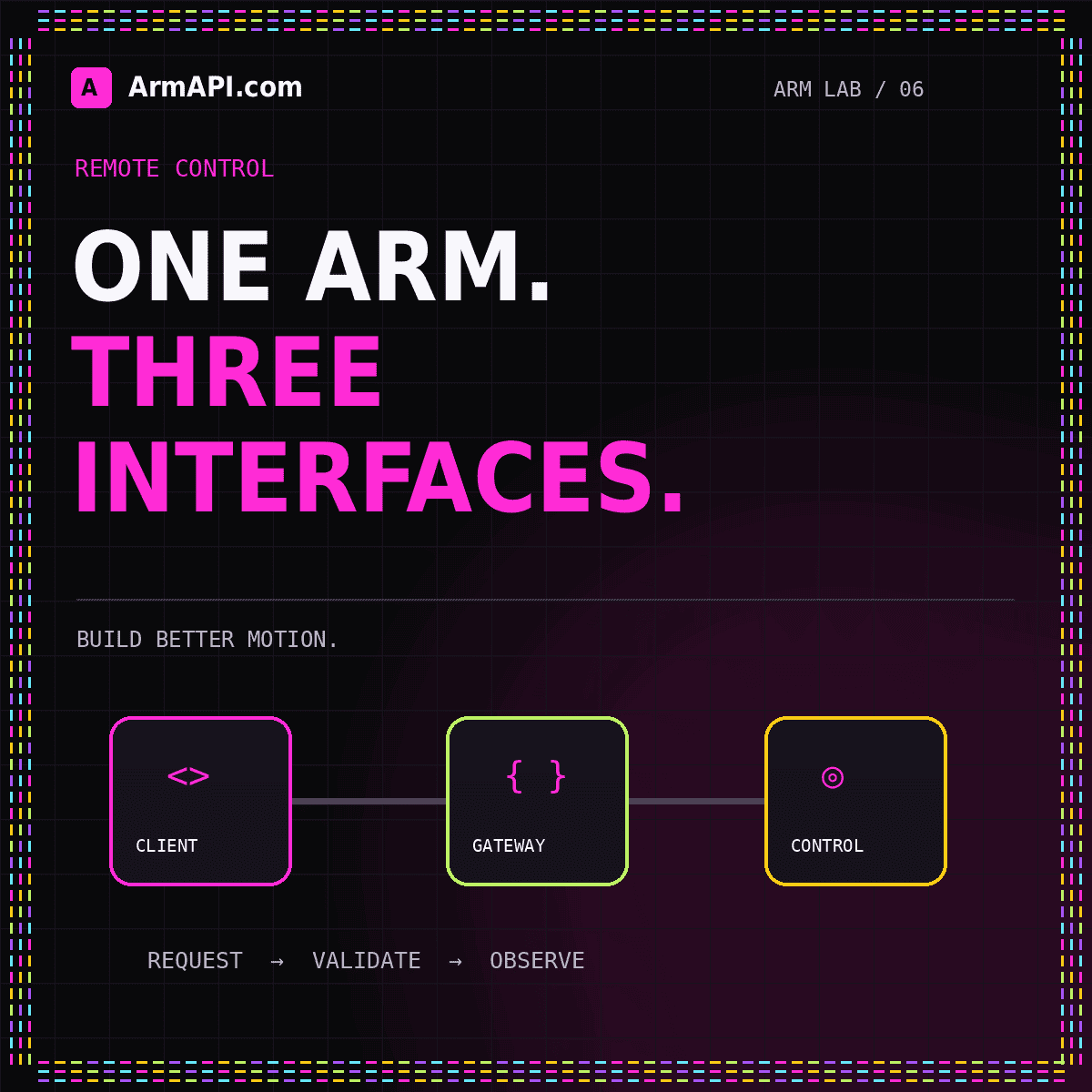
Choosing a transport for a robot arm API starts with a more useful question: what kind of interaction are you trying to represent? Reading configuration, observing changing state, and requesting a monitored motion are different jobs. A system can use more than one communication pattern without being inconsistent, provided the boundaries and responsibilities are clearly documented.
This guide proposes a browser-to-gateway-to-controller architecture for a hypothetical teaching cell. It does not claim that ArmAPI.com operates a hosted endpoint or supports a particular robot. The Remote Control Arm API page provides the broader context. The objective here is to assign each kind of work to an understandable interface, not to declare one technology a universal winner.
Begin with the application contract
List the operations your application actually needs. For the teaching cell, that might be read capabilities, read current state, request a reviewed task, observe its progress, and request cancellation. Give each operation an expected result and failure behavior before selecting libraries. Otherwise, the available convenience methods in a framework can accidentally determine the robot’s external contract.
Separate command identity from connection identity. A socket may reconnect, a page may reload, or an HTTP request may time out while the underlying task continues. The logical task should remain identifiable through those events. Store a durable command identifier in the application’s design, and define how clients can retrieve the outcome without resubmitting the work.
Also decide which component is authoritative for each piece of information. The browser owns presentation preferences, not robot state. The gateway may own authorization decisions and command records. The controller reports execution state within its own contract. Explicit ownership prevents duplicate caches from quietly becoming competing versions of the truth.
Use request and response for bounded exchanges
A request-response interface is a natural shape for reading a capability document, fetching a configuration revision, or asking for a command record. Each request has a defined scope and a response that can be inspected independently. For a web-facing design, these operations can be represented as resources with stable identifiers rather than a collection of vaguely named action buttons.
Do not make a long motion look complete just because the submission exchange finished. A gateway can acknowledge that it accepted work and return a task identifier. The client then observes or retrieves the eventual result separately. This distinction makes timeouts easier to interpret because submission and execution no longer share a single ambiguous success flag.
Document retry behavior per operation. Reading state and requesting new motion have different consequences when repeated. For commands, define how a stable idempotency key maps to a stored operation and what happens when the same key is reused with different content. A transport method name alone does not establish that duplicate motion requests are handled correctly.
Use streams for observations with clear ordering
A streaming connection can carry changing observations and progress events without requiring the interface to request every update individually. In the proposed architecture, the stream is a view of authoritative state, not the authority itself. Each event should identify its source, sequence, and relevant command or scene revision so the client can interpret it after delays or reconnects.
Design for a slow consumer. The interface may not need every intermediate joint display sample, but it does need important task transitions. Separate replaceable observations from events that must remain recoverable. If the client falls behind, a fresh snapshot plus a well-defined event cursor may be more useful than replaying an enormous backlog of outdated visual positions.
Keep the stream’s health visible. A connected socket does not prove that the underlying robot observations are fresh. Show the age of the last relevant state record and preserve an unknown or stale condition when needed. Do not let an animated connection indicator obscure a stopped publisher or an unavailable command result.
Use robot-native actions where their semantics fit
The ROS 2 action design specification describes goal-oriented interactions with feedback, results, and optional cancellation. It distinguishes actions from one-way topics and bounded service exchanges. These documented semantics are useful when a task takes time and the client needs to follow its progress rather than treating it as an instantaneous function call.
A web gateway can translate its application-level task model into a robot-native action, but the translation needs an explicit mapping. Which action states correspond to the browser’s accepted, executing, canceled, or failed states? Which errors preserve a recoverable command record? What happens when the action server becomes unavailable after accepting a goal?
Do not discard useful semantics at the boundary. Wrapping an action in a generic success response can hide cancellation and outcome information that the robot interface already provides. Conversely, do not imply that every browser command corresponds to a native action. Configuration reads and scene observations may use different mechanisms, and the reference should explain those choices.
Keep the gateway deliberately narrow
The gateway is a place to enforce identity, permitted operations, schema validation, and command ownership before requests reach a robot-facing adapter. It should not be a public tunnel to every internal topic or service. Exposing the entire control graph may be convenient for an experiment, but it creates an external contract far larger than the application actually needs.
Use a small adapter boundary for hardware-specific behavior. The application can work with task identifiers and capability descriptions while the adapter handles the selected controller’s message types and limitations. Unsupported behavior should return an explicit capability error. Quietly emulating an unavailable feature can produce a result with different guarantees from the one the caller expected.
Keep physical safety functions outside the authority of ordinary web traffic. A narrow gateway is a software architecture measure, not a safety certification. Controller configuration, safeguarding, local supervision, and commissioning still require their own engineering process. No choice among REST, WebSocket, or ROS 2 removes those responsibilities.
Compare designs with a concrete failure exercise
Take one scenario: a task is accepted, the progress channel disconnects, and the browser reloads before the task ends. Ask how each proposed architecture recovers the task identifier, retrieves the last known outcome, and decides which controls to enable. A design that cannot answer this clearly is not ready merely because its normal-path demonstration feels responsive.
Next, consider two clients requesting work simultaneously. Identify the component that decides ownership and the response each client receives. Then test a gateway restart, an old observation arriving late, and a cancellation request whose result is unavailable. Write expected transitions in a table and verify them with a fake controller before involving equipment.
Measure complexity as well as speed. A transport that requires custom recovery logic may be reasonable for one project and unnecessary for another. Prefer the smallest set of mechanisms that preserves the required semantics. Fewer technologies are not automatically simpler if one connection is forced to handle incompatible responsibilities without a clear contract.
Write one protocol-independent example
Describe a task with a plain event sequence before translating it into transport-specific code: request submitted, permission checked, work accepted, progress observed, result recorded. Add a cancellation branch and a missing-result branch. If those sequences remain understandable without naming a library, the application contract is likely taking shape. Map the same sequence onto the selected transports and note every piece of meaning that needs an adapter. This approach makes future transport changes less disruptive because the user-visible semantics are not hidden inside one framework’s callback conventions.
Conclusion: choose semantics before sockets
A thoughtful robot arm interface often combines bounded requests, state observations, and monitored tasks. The quality of the design comes from how those interactions preserve identity, ordering, permission, and uncertainty across boundaries. Technology selection should follow those requirements rather than substitute for them.
Review remote-control failure handling and the API security checklist before exposing any command path. For a small working interface with no network connection, inspect the local demo reference. Its deliberately limited contract is a useful reminder: a well-defined boundary is more valuable than a long list of vaguely supported transports.


